
Two Kinds of Smart
AI is smart, but in some instances a 22-year-old graduate can run circles around it.
On October 29 I spent an afternoon with a room of FGCU finance students who graduate in December. Near the end came the question every graduating class now asks: what do we need to learn to stay competitive with AI? Underneath it sits a fear that is hard to miss. They spent four years acquiring a body of knowledge, and they are about to start work next to a machine that holds more of it than they ever will.
I think that fear has it backwards. Intelligence comes in two kinds. AI has an enormous amount of one and very little of the other, and the one it lacks is the one a 22-year-old has most of. What a 22-year-old lacks, years of accumulated knowledge, is now at their fingertips if they learn to use the tool properly.
Young people should not be scared of AI. They should embrace it, learn how to use it, and then use it to their advantage.
The views expressed are solely my own and do not represent the views of Ava Labs, the Avalanche Foundation, or any affiliate of either organization.
This newsletter is for informational purposes only and does not constitute financial, investment, legal, or tax advice.
Nothing herein should be construed as an offer or solicitation to buy, sell, or engage in any digital asset or financial instrument.
Table Stakes First
The first part of my answer to the class was boring, and I said so. Learn AI! Live in it. Don't stop at ChatGPT: use the coding agents, the research tools, all of it. Any task you do on a computer, find a way to do it with AI, because that know-how is valuable in itself.
If you want to be good at tennis, you pick up a racket and swing it thousands of times until it is muscle memory. Do the same here with AI. Even for something as dull as checking your email, or browsing the internet, try to insert AI in that process so you build that muscle memory. The tools will change. The reflex to reach for them will not.
Twenty years ago someone in that classroom might have been told to learn the internet. Today there is no course on the internet; the university assumes you arrive using it. AI is heading the same way: in a few years' time, it will be assumed that young professionals and college grads are fluent in AI, so you might as well treat it as assumed starting today.
This gets you in the game. To know what to do once you are in, you need to know what you are working with. That starts with a question that sounds academic and turns out to be the most practical one in the room: what is intelligence, really?
Fluid and Crystallized
Psychologists stopped treating intelligence as one thing a long time ago. In 1943, Raymond Cattell split it in two:
- Fluid intelligence is thinking on your feet: reasoning through a situation you have never seen and making the right call without a precedent to lean on.
- Crystallized intelligence is making connections between things you have already learned. It is the accumulated, connected body of what you know, and the ability to apply it.
You will meet both kinds of smart in your career, usually in different people.
Picture a 60-year-old corporate lawyer who has followed every major case of the last twenty years. Ask a question and he goes straight to the connections: this company won that suit, this one lost, the court ordered this, so here is the likely outcome and here is how I would document it. That is crystallized intelligence, deep and hard-won.
Now picture a 25-year-old trader making split-second decisions in a market that is doing something it has never done before. No precedent fits cleanly, and there is no time to look one up. That is fluid intelligence. Both people are very smart. They are not smart in the same way.
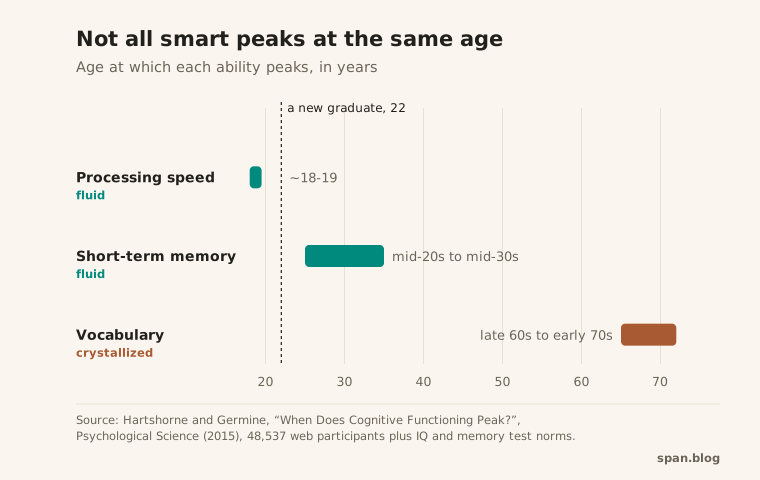
The two also age differently. In one of the largest modern studies of the question, Hartshorne and Germine (2015, more than 48,000 participants) found that processing speed peaks around 18 or 19 and short-term memory levels off in the mid-20s before declining from the mid-30s. Vocabulary, a classic crystallized measure, keeps climbing until the late 60s or early 70s.
A Billion Books
So what kind of intelligence does the "I" stand for in AI? Think of it as someone who has read a billion books, can recall all of them, and can connect any one of them to any other. That is crystallized intelligence at a scale no human has ever had.
Writing a computer program is the easiest example. The syntax is all out there: everyone agrees what an if statement is, what a while loop does, what a class is. It is a codified body of knowledge, and you can unleash that kind of intelligence on it and get the answer you want. The tax code is the same. An accountant understands it from years of memory. A model reads all of it, keeps all of it, and connects the sections faster than anyone.
This is where we keep fooling ourselves. In people, the two kinds of smart travel together. Someone with deep knowledge almost always had the reasoning to acquire it. Going back to the two types of intelligence: fluid intelligence is what you spend in your younger years to build crystallized intelligence in your later years. So we have always read knowledge as evidence of reasoning, and exams, credentials and hiring all lean on that shortcut.
AI is the first thing we've met with huge crystallized intelligence and much thinner fluid intelligence. When it passes the bar exam we assume it reasons like a lawyer, because that held for every human who ever passed.
But AI in fact does not reason like a lawyer. The bar exam is a good example of the shortcut breaking. OpenAI reported in 2023 that GPT-4 scored around the top 10% of test takers. When an MIT researcher re-ran the comparison against people who actually passed, the estimate fell to about the 48th percentile overall and the 15th on the essays (Martínez, 2024). The multiple choice, where recall carries you, held up. The essays, where you have to build an argument, did not.
Garbage That Sounds Intelligent
Where AI struggles, and in my experience struggles badly, is fluid intelligence. The trouble is that it does not sound like it is struggling. LLMs are what's behind the AI that we use today. LLM stands for "Large Language Model". Language is what AI was trained on. Therefore, AI always sounds polished, and the polish can fool you into thinking something intelligent just happened.
Give it five companies and the numbers, and it will analyze them well: who has the strongest balance sheet, and who has the best cash flows. Ask it for the next step (who should seek a buyout, who should pursue M&A, who should be cost cutting) and you get proper grammar, proper sentences and very little substance in it. It will not give you something right, because the answer is in none of the billion books.
The clearest example I have is this newsletter. As I said in August, I write these pieces with an AI agent. I talk through the ideas, usually out loud, and it organizes them into an argument and checks the numbers. That works very well. But if I ask the same agent to write a piece from scratch, with no direction and no context, what comes back reads beautifully but is useless to me. AI cannot supply direction. It can only elaborate the direction you give it.
Why This Is Good News If You're 22
Now put the two halves together. If you are 22, the kind of smart AI is weakest at is exactly the kind you are best at right now. Your fluid intelligence is at or near its peak, and chances are you have more of it than the bosses who are about to hire you. The kind you are missing, the decades of reading and experience, the kind your bosses flaunt, is what the machine hands you for free, if you know how to use it.
But wait, there's more. You have a second advantage, for better or worse: a lack of priors. Every situation at work is a new situation for you, so you attack it with fresh eyes and with nothing to unlearn. For most of history that was the cost of being junior. It might now be the point.
But hang on, if I were right and that were the whole story, AI would be competing hardest with experienced bosses and leaving 22-year-olds alone. Instead, Stanford's payroll data puts employment for 22-to-25-year-olds in the most AI-exposed occupations 19% below where it would be had it kept pace with less-exposed peers, as of June 2026. I went through this in my last piece, and it is true. So what gives?
The answer: look at what junior employees are hired to do today. Build the presentation, write the memo, do the write-up, populate the Excel model. All of that is interpolation, repetitive work of the crystallized kind. It is the one thing a 22-year-old is worst at compared to the machine, and the entire entry-level job has been built out of it. We have been hiring people at the peak of their fluid intelligence and paying them to regurgitate knowledge.
In my view, that is the job description failing, and the 22-year-olds are taking the blame for it. A firm that sees a machine build the deck and concludes it needs fewer juniors has read half the data. The other half is that it now has someone cheap, quick and unburdened by priors who no longer has to spend two years on decks. Nobody has worked out how to hire for that yet, because the transcript and the interview both measure the crystallized kind.
Until they do, the job falls to you. This is the most important message a college grad should understand. It is your job to play to your strengths of high fluid intelligence. And the way you do that is by wielding the sword of AI to cut through all the repetitive tasks that juniors are expected to do.
The regurgitation should take five minutes, and if it takes a day, you are spending your best asset on the work the machine does better. You have looked at five companies, you know what the numbers say, so what do we do? You have the tax code at your fingertips, so how should the company restructure over the next two or three years to use it? That is where you add value, and increasingly it is the only place you get paid to.
Read the Game
How we do things is crystallized intelligence, and AI will do the "how." The "why" is yours, and you build it by asking.
On your first day, when someone explains how something is done, ask why it is done that way. Just do it gently and not more than two "whys" at a time, or you will start annoying people.
Everyone who studies taxes learns that the top federal rate on ordinary income is 37% (as of 2026) and the top rate on long-term capital gains is 20%. Almost nobody asks why. Part of the answer is incentive: we want people to invest. The other part is subtler. $100 left alone does not turn into $200. It takes capital and labor, the labor is already taxed, and taxing the capital again at the full rate starts to look like taxing the same income twice. That's some nice intuition we gained by just asking why.
Now to be honest, an AI could tell you that, since the question is in plenty of textbooks. The habit of asking why is the point, because one day you will ask a why that is in none of the billion books. Ask it often enough and you stop seeing a list of procedures. You start seeing how the pieces push on each other, and where they are likely to go next.
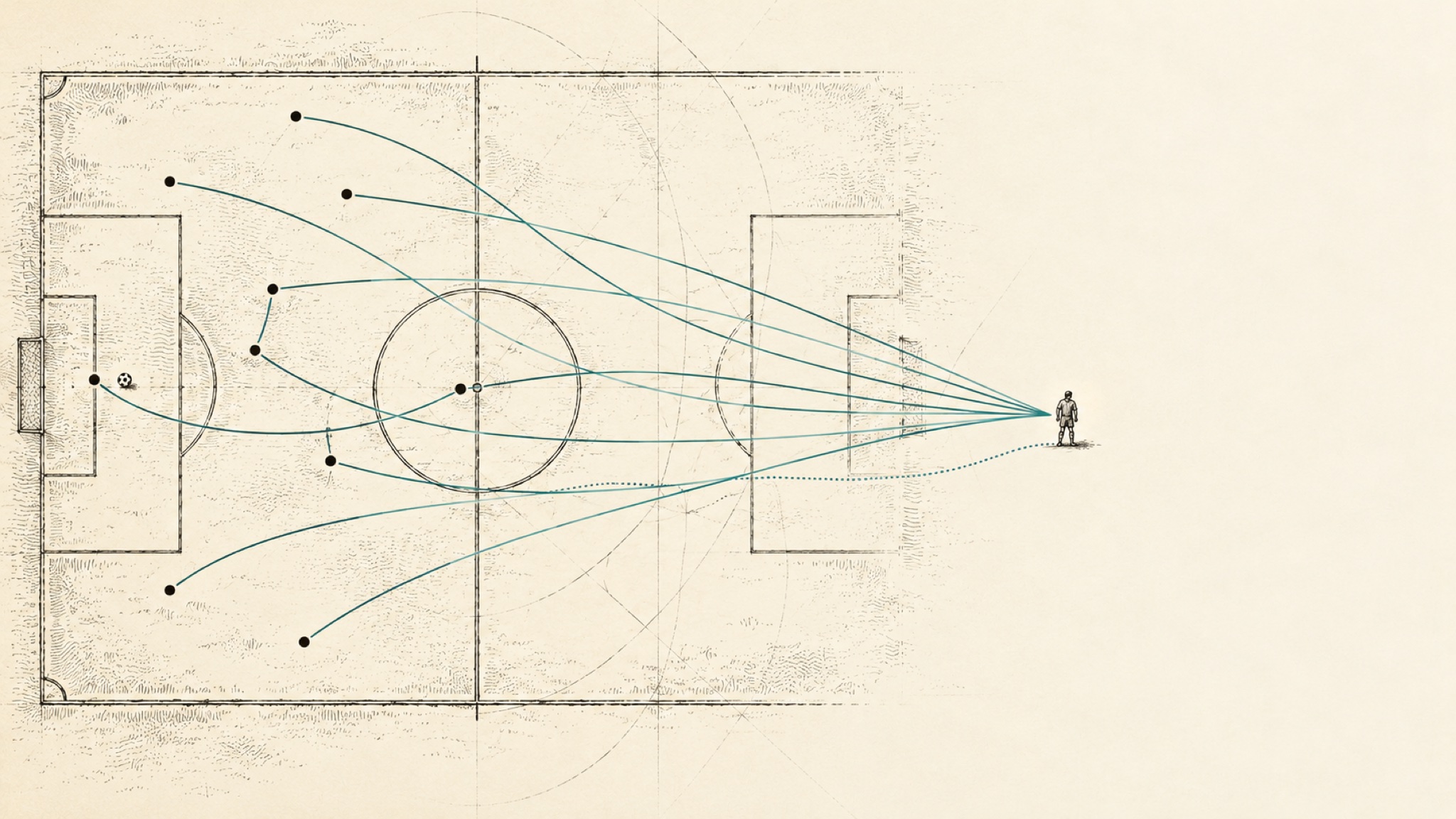
Paolo Maldini, arguably one of the best defenders in soccer ever, is famously quoted as saying that if he has to make a tackle, he has already made a mistake. His job was to read where the play would be in five or ten seconds, and to be standing there before anyone else knew it mattered. Finance works the same way: most of what we do is working out where the economy, the markets or the policy are going, and getting positioned before they arrive. That is the question the machine answers so eloquently and so wrongly.
Young players are taught to dribble, shoot and tackle, and for a long time that was the path. There is now a machine that does the dribbling, shooting and tackling better than anyone alive. So do not spend your prime years learning a process. Learn to read the game.
Enjoyed this? Subscribe for the next deep dive, or drop me a line at akram@span.blog.