
Who Does the Extrapolation?
AI freed us from the interpolation grind. Nobody freed up the attention it takes to do what's left.
In August I argued that AI is an interpolation engine: it matches new situations against the codified body of human knowledge, which is why it swallowed contract review, code, and audit sampling, and why it has produced no new physics. Most professional work is interpolation. So the premium migrates to the rare thing, extrapolation: pushing the body of knowledge outward, into territory where there is nothing to match against.
That piece left two questions open, and they are harder than the one it answered. If extrapolation is the work that still pays, are we producing people who can do it? And is there a way to teach it?
I have a personal stake in both questions. I am halfway through the fall semester at the university where I teach, and the students in front of me are the most AI-native cohort in history. In the UK, 94% of students now use generative AI for assessed work, up from 51% a year earlier (HEPI survey, fieldwork December 2025). The machine that does the practice problems arrived before anyone decided what the practice was for.
The views expressed are solely my own and do not represent the views of Ava Labs, the Avalanche Foundation, or any affiliate of either organization.
This newsletter is for informational purposes only and does not constitute financial, investment, legal, or tax advice.
Nothing herein should be construed as an offer or solicitation to buy, sell, or engage in any digital asset or financial instrument.
No Attention, No Mastery
Screenwriters who have worked for Netflix told n+1 about one recurring note: have the characters announce what they are doing, so a viewer with one eye on their phone can still follow the plot. Netflix denies any such rule ("There is no such principle," film chairman Dan Lin said in March 2026), but the note became an Oscars joke because everyone in the room recognized the product it describes.
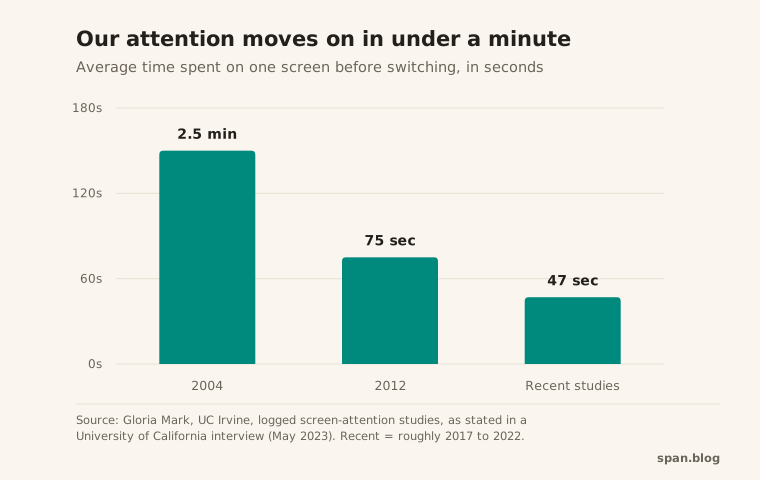
The assumption behind it is priced correctly. Gloria Mark at UC Irvine has logged screen attention for two decades, and in her recent studies the average stretch on any one screen is about 47 seconds, down from two and a half minutes in 2004. Teenagers have it worse: Common Sense Media's 2023 device logs show a median of 237 notifications a day.
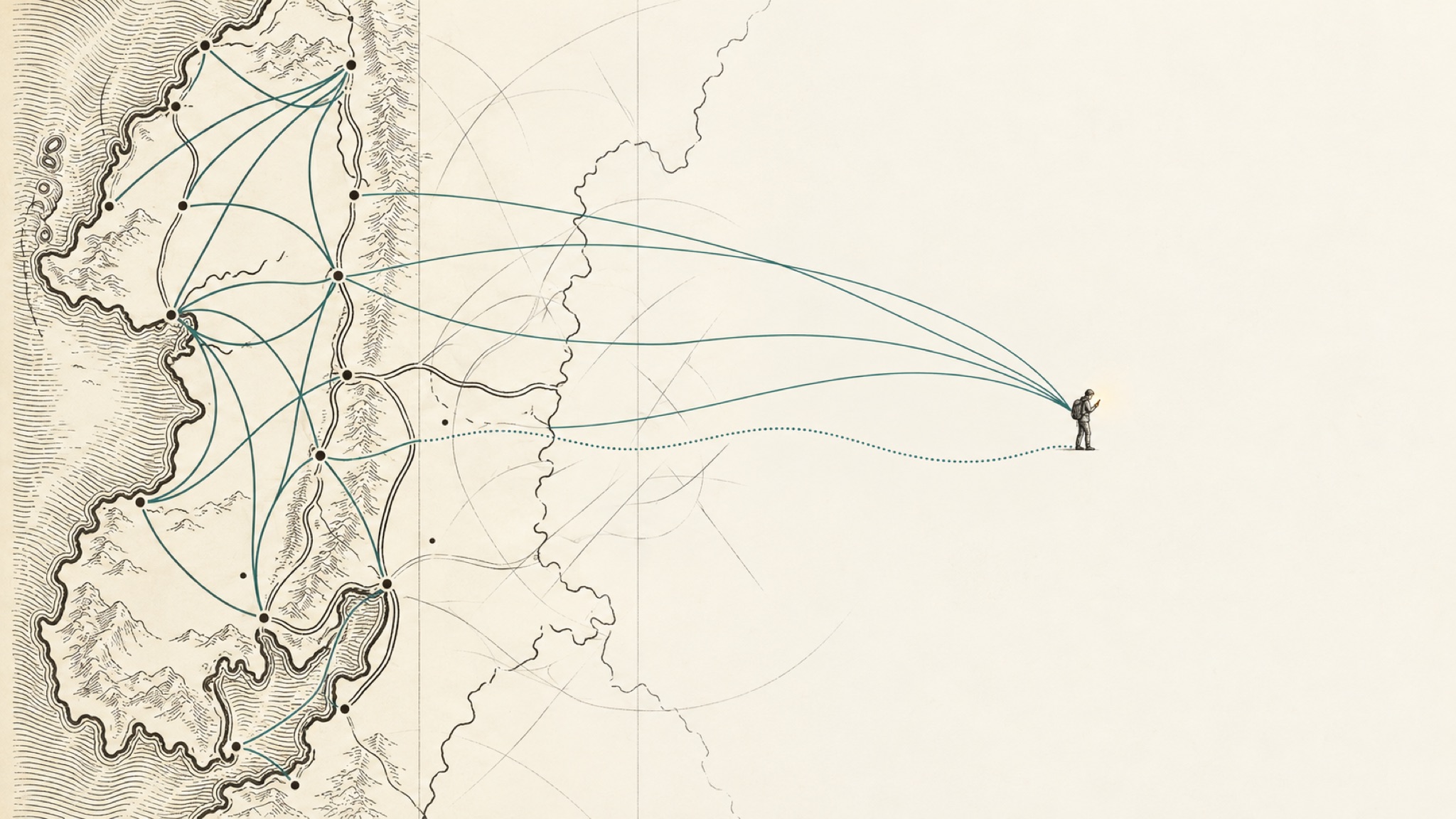
Think of everything we know as a map. Interpolation is moving around inside it: taking a new question and finding the nearest answer already charted. Extrapolation is drawing past the edge, and you can only do that if you know where the edge is.
That is why a markets newsletter cares about screen time. Extrapolating knowledge comes from mastery, and mastery has a known manufacturing process. Anders Ericsson, who spent his career studying it, called it deliberate practice: effortful work at the edge of your current ability, with feedback, sustained for years. Mihaly Csikszentmihalyi named the state it requires, flow: concentration deep enough that self-consciousness drops away. Deliberate practice is measured in unbroken hours. The average screen session is measured in seconds. Those two facts cannot coexist in the same person for very long.
So the chain runs: engineered interruption destroys flow; no flow, over years, means no mastery; and mastery is the precondition for the one kind of work AI does not do.
The environment we live in has been weaponized against our focus.
Read that as a description of a business model. Engagement is the intermediate good, revenue is the product, and some of the best-funded engineering teams on earth are paid to keep you scrolling. A society that says it prizes innovation has built its most sophisticated commercial machinery to break the one state innovation requires, at the exact moment the AI economy made that state the scarce input.
The obvious objection is that every generation says this. Socrates worried writing would destroy memory, and the novel, the radio and television each took a turn as the end of serious thought. What is new is the optimization: firms running controlled experiments at industrial scale to lower the interruption threshold, and writers saying so on the record. Not all divided attention is predation, and the few who push frontiers can still protect their focus (the disciplined ones do), so frontier output may hold up even as fewer people are able to join it. Fewer extrapolators and less extrapolation are different claims. But that concession turns the question into who gets to join, and the pipeline into every profession I know runs through the same institution.
School Teaches the Thing AI Does
A degree program takes a codified body of knowledge and trains you to match new situations against it. That is the definition of interpolation. In the one field where somebody bothered to count, the numbers are stark: an analysis of 9,713 exam questions from fifty introductory biology courses found 93% tested recall or restatement, the two lowest cognitive levels (Momsen & Long, 2010).
The tempting fix follows immediately: if AI does the interpolation, stop teaching it. Rebuild the curriculum around creativity, judgment, "higher-order thinking." I believe this is the single most damaging idea in the current education debate, because you cannot extrapolate from outside the interpolation space. You cannot expand a body of knowledge you never absorbed. The expertise research is close to unanimous that there is no domain-general critical thinking floating free of domain knowledge; in the cases on record, the people who pushed a frontier had internalized the existing corpus first. On Wall Street we trained juniors through years of supervised matching (the pitch book, the doc mark-up, the model audit) because doing it is how the corpus gets into a person.
The cleanest way I have found to say this: AI is a multiplier, not an addition. It multiplies what you bring; if you bring nothing, zero times anything is zero. A $3,000 golf club does nothing for an amateur's game. A top-ten player extracts the extra half percent from it, and the better the player, the more the same equipment returns. That is why you learn the craft the old way: so there is something for the tool to amplify.
Here is the trap, and it is the sharpest fact in this piece: the grind that installs the corpus is exactly the work AI absorbed first, so the grind stopped paying. Stanford's payroll-data work now puts employment for 22-to-25-year-olds in the most AI-exposed occupations 19% below where it would be had it kept pace with less-exposed peers, as of June 2026 data, widened from 15% a year earlier. At firms adopting AI fastest, senior headcount grew 31% against 6% for junior roles over the past year, per Revelio Labs' July 2026 tracker. The bottom rung is being priced out of the ladder while the students climb onto it: recall that 94% figure from the opening.
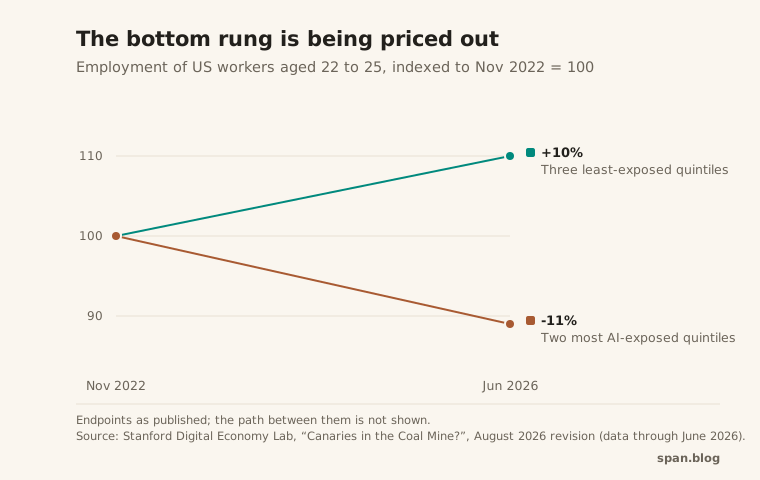
The August revision of that Stanford work did something more useful than move the number: it named the dividing line, and it is the one my last piece drew. Employment fell for young workers in occupations that rely on "codified knowledge: formal, standardized, documented knowledge that can be taught through education, textbooks, or written procedures," and rose for experienced workers whose jobs rest on tacit knowledge. The authors call these descriptive patterns rather than causal estimates, and I will treat them that way. But read that first definition again. It describes what a degree is.
So why would a student grind through work the market has just marked to zero and the machine in their pocket does free?
I put that question to myself on September 3, handing out the first take-home quiz of the semester. Five questions, unlimited time. I told the room plainly that if they pasted the quiz into a chatbot it would hand back every correct answer, no questions asked, and asked them to try each problem first anyway. The analogy I reached for was the doctor who tells you to lose weight, so you start running three miles a day, and then you notice you could drive the three miles instead. Same distance, faster, no effort, no result. The analogy has a weakness the sharper students will find before I do: nobody hands you a diploma for running. The chatbot does the graded work the credential is actually made of, which means my appeal is not to their self-interest as the university has defined it. It is an appeal against it.
Because the grind was never the destination. Schools should keep teaching interpolation; the prerequisite trap leaves no alternative. But they should teach it the way a boxer runs miles, and no boxer thinks the fight is a footrace. Today the grind is taught and certified as if it were the point, and the certificate just lost its economic floor. My read is that the institutions that survive this decade are the ones that re-aim the same grind at a different target: master the corpus in order to push past it.
The grind was never the destination. The frontier was.
Should We Educate for Jobs?
Everything above rests on an assumption I should say out loud: that we are still educating people for jobs. Formal education has always had two purposes, making better workers and making better people, and since mass schooling employability has won by default because it is the one goal nobody objects to.
AI is the first technology in a century that could break that premise. If machine interpolation removes enough paid labor, and society settles into some version of supported non-employment, then the question that has been dormant since industrialization comes back with force: what is school for, if not a job? I don't know the answer, and I distrust anyone who claims to.
And the question loops back to attention. A job is, among other things, a discipline: hours you have to show up for and problems you have to finish. My read is that if you take it away, the free day does not fill with flow. It fills with whatever has been engineered most carefully to fill it.
What I know is that the two questions this piece opened with have the same shape at every scale. Who does the extrapolation? And are we building people who can, or an environment that quietly guarantees they can't?
Next: why we keep misjudging what AI is good at. It knows more than anyone you have ever met, and knowing is only one kind of smart.
Enjoyed this? Subscribe for the next deep dive, or drop me a line at akram@span.blog.